
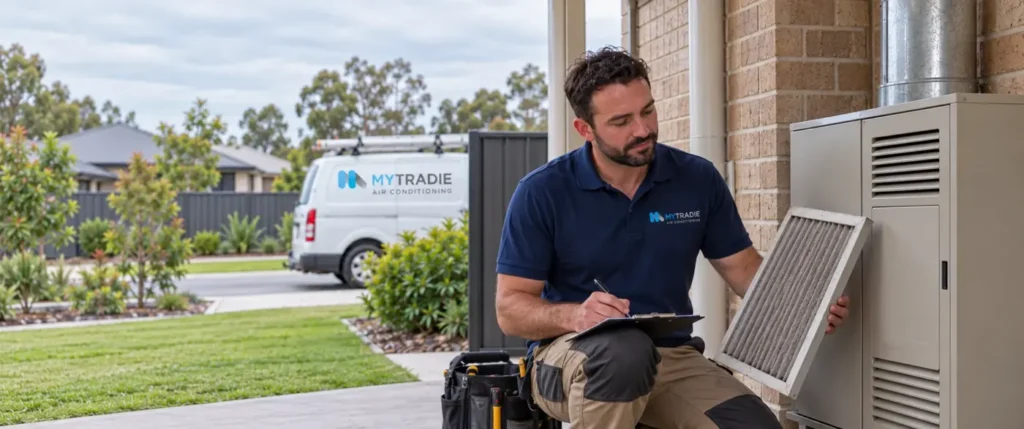
An owner can review the accessible surroundings of a gas heater and record concerns. This is not a gas installation, repair, leak-test or combustion-check tutorial. Those tasks need the appropriate licensed professional.
Need help before you start? Ask MyTradie for a quick overview of your system.
Before you start
Identify the heater and read its owner safety instructions. Perform only an ordinary observation from a safe position with the appliance shut down and cool as the manual requires.
Step-by-step tutorial
- Identify required clear spaces. Use the exact manual for the appliance. Do not copy a clearance number from a different heater or installation.
- Move loose household items safely. Keep clothing, paper and other combustibles away from the required clear area without touching the heater, pipes or flue.
- Look at ventilation openings. Do not cover or close required grilles or air openings. Record an obstruction you cannot remove safely.
- Record visible concerns. Note damage or deterioration from an accessible position. Do not open a casing, adjust a gas fitting or test a flame.
- Check the service contact. Keep the model and service history ready. Queensland guidance requires licensed gasfitters for gas servicing and other gas work.
Would you like the heater professionally assessed? Contact our team about the right service or call 0402 155 761.
Check the result
The useful result is a clear surroundings record and a plan for any concern. A tidy area does not prove the heater is safe internally or replace its scheduled professional checks.
Stop and get professional help if needed
If you smell gas, stop this routine and follow your gas supplier’s and Queensland emergency guidance; do not operate switches or create ignition sources. Use emergency assistance for immediate danger. Do not wait for a routine quote to address a suspected leak.
A common question
Can I clean or adjust the gas components while checking?
No. Limit the task to the accessible surroundings and permitted owner care. Gas fittings, combustion components, flues and internal repairs must be handled under the appropriate licensing arrangements.