
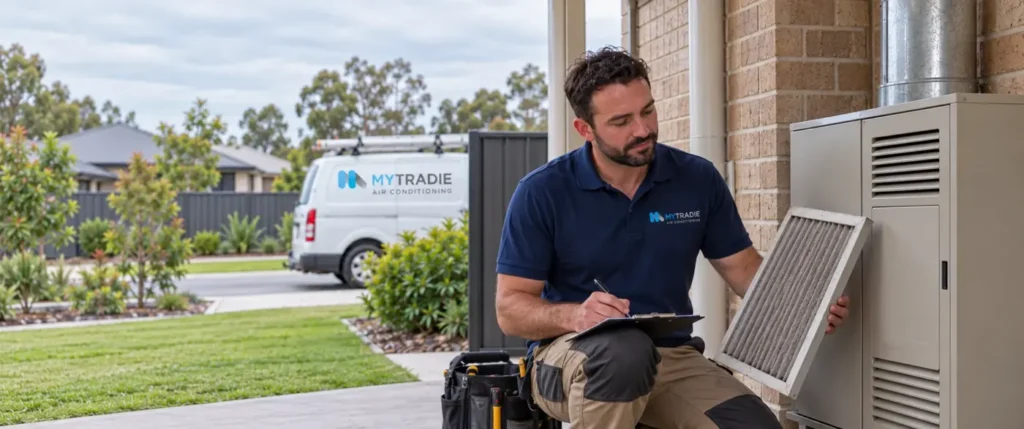
Retrospective planning guide — February 2026. Newly prepared and published on 1 November 2026 for this earlier planning period. The archive date is not evidence of an earlier publication. Period sources are listed below; confirm current products, terms and site requirements before acting.
Late February 2026 was a useful planning point for households and property managers looking beyond summer cooling. An autumn heating review could identify records, user questions and service discussions before the equipment was needed more often. This guide covers preparation and decision-making for reverse-cycle and gas-heating arrangements, while leaving technical inspection, gas work and electrical work to the appropriately qualified people.
Planning a real job? Contact MyTradie for a practical scope review and quotation discussion.
Identify what heating equipment the property actually has
List the systems and the spaces they serve. Distinguish reverse-cycle air conditioning from ducted gas heating or another heating arrangement rather than describing every wall controller as an air conditioner. Record the manufacturer and model from existing paperwork or a safely accessible label, and mark uncertain details for confirmation.
For gas equipment, retain the correct model instructions and known fuel information where documented. Do not infer compatibility from a similar-looking heater or controller. Owners and agents should not open a combustion compartment or access a roof space to fill gaps in a planning checklist.
Ask occupants how the home will be used in cooler weather
Record the rooms occupied in the morning, evening and overnight, along with any changed household needs. A new home office or an occupied room that was formerly unused can affect the discussion. Keep comfort preferences clear without attempting to prescribe a technical design from the occupancy list.
Ask whether users understand the normal heating controls and where the instructions are kept. A controller explanation may resolve a misunderstanding, but it should not be used to dismiss a reported fault. Note the difference between “I do not know how to select heating” and “the system behaves abnormally when heating is selected”.
Review the service history and outstanding recommendations
Find the last professional report, installation information and any unresolved fault correspondence. Record the equipment attended, work completed and recommendations that still need a decision. A date in the calendar is less informative if nobody knows which system was included or whether access prevented part of the agreed work.
Keep the correct owner manual with the service records so that model-specific maintenance requirements can be checked. Use the actual instructions and relevant professional advice for your equipment, rather than turning this article into a universal service interval. If records are missing, explain that uncertainty to the provider and ask what assessment is appropriate.
Make the next step specific. Ask our team about the relevant service, or call 0402 155 761 with the property suburb, equipment details and your proposed timing.
Keep owner observations within safe limits
From a normal safe position, note visible damage, obstructed ordinary access or a reported controller message. Do not dismantle equipment, adjust gas controls, alter flues, bypass a safety device or make electrical changes. An autumn review is an organisational task, not permission to carry out a test procedure found in a technical manual.
If gas is suspected to be leaking, there is abnormal electrical behaviour or another immediate safety concern, follow current emergency and supplier guidance for the circumstances. Do not wait for a routine quotation or use a blog checklist as an emergency response plan. Appropriate urgent assistance takes priority over preparing maintenance paperwork.
Prepare a clear heating-service enquiry
Tell the provider the system type, model information, property suburb, observed concern and proposed timing. Explain access restrictions and who can authorise an assessment or further work. Ask the provider to confirm the appropriate trade scope for the equipment, particularly where gas, electrical and air conditioning work may require different qualifications.
Keep the request specific. A normal reverse-cycle control demonstration, a gas-heater safety-related assessment and a replacement quotation are different enquiries. The family-owned MyTradie team can discuss the request and confirm scope and availability; an online article should not promise that every task or licence category is covered without that confirmation.
Compare repair and upgrade options without a universal winner
If replacement is being considered, ask for options based on the property requirements, equipment condition, access and operating pattern. Preserve the assumptions behind any running-cost estimate and identify the exact proposed system combination. A general statement that one fuel or brand is always cheapest is not a substitute for a relevant comparison.
For reverse-cycle products, use applicable model and climate information when reviewing efficiency claims. For an existing gas system, ask what the proposed work includes and how current requirements will be addressed. Confirm current product availability and terms, since this is a retrospective planning guide rather than a live equipment catalogue.
Give the autumn plan an owner and a follow-up date
Assign each action: locating documents, arranging an assessment, deciding on a quotation or improving the user handover. Keep outstanding matters visible until they are resolved. If a property changes occupants, transfer the relevant instructions and service contact through the appropriate secure process.
An illustrative managed home may need only a clearer operating guide and a professional review of an outstanding recommendation. Another may require a broader equipment assessment. A useful autumn plan preserves that distinction and gives the responsible person an understandable next step, without claiming that a pre-season visit guarantees fault-free operation throughout winter.
Your working checklist
- Identify the actual heating systems and the rooms served.
- Record cooler-weather occupancy and ordinary control questions.
- Gather service reports and unresolved recommendations.
- Leave internal, gas, flue and electrical work to qualified professionals.
- Agree the assessment scope, authorisation and follow-up responsibility.
A question worth asking
Should I run a gas heater myself to check whether it is safe?
A brief period of operation cannot establish gas-heater safety. Follow the correct owner instructions and arrange appropriate professional assessment where required or where there is a concern. Do not open equipment or attempt gas, combustion or flue tests, and use current emergency guidance if a leak or immediate danger is suspected.
Period sources and further reading
These references support the technical background. The planning examples and checklists are illustrative, not records of completed customer projects.